

{{ name }}
Article no. {{ combinedCodeWithHighlight }}
Article code:
EAN / GTIN:
Manufacturer number:
Cat. Nr.:

Lithium ion batteries are now an indispensable part of everyday life. They are used in smartphones, laptops and tablets as well as cordless screwdrivers and drills due to their high energy density and compact design. Their fast charging and high efficiency level of up to 95% also explain why lithium ion batteries are so popular, but they also present some risks. You can find out how you can protect yourself and your production environment from harm and damage due to battery fires on this page and in our QuickTip on this topic.
You often hear about lithium ion batteries that catch fire out of the blue, but this shouldn’t cause you to panic. Overheating can be caused by incorrect handling or damage to the battery. This overheating can be attributed to thermal runaway, which comes about as a result of the electrochemical structure of lithium ion batteries. Lithium is a highly reactive metal that can easy react to other substances, which can result in high temperatures. These high temperatures can be further aggravated by the use of flammable and combustible substances in the electrolytes. A fault in or damage to a cell within the battery pack may even be enough to trigger an escalating process in which the temperature rises further and further.
When a critical temperature is reached, an uncontrollable chain reaction may start, which can lead to battery runaway. It is therefore important that you properly store and charge your lithium ion batteries and avoid any damage, in order minimise the risk of overheating and therefore the risk of fire.

The most important thing to bear in mind when storing a lithium ion battery is that you only store it in accordance with the manufacturer’s specifications. This also applies if there is no safety data sheet. In this case, we recommend that you follow the user information. Regardless of this, when it comes to storing Li-ion batteries we recommend protecting them against short circuits, damage as well as falls and tipping over.
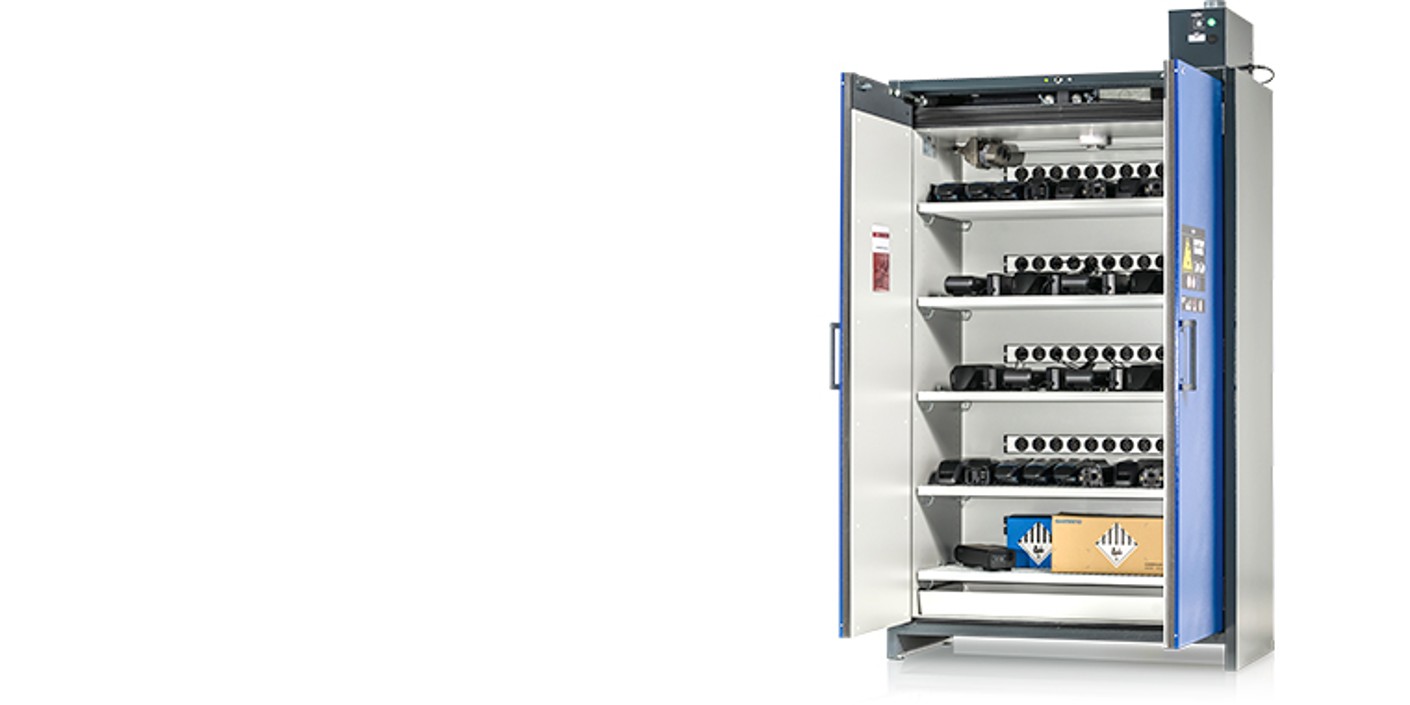
The basic rules listed above for safe storage also apply to charging. Furthermore, you should make sure that you only use suitable chargers. You should also observe the specifications regarding temperature, moisture, dirt and dust.
Safety cabinets are the ideal solution for storing and charging Li-ion batteries, as they can be used for not only correctly storing batteries, but also protecting the environment against possible hazards. They not only provide protection against internal factors, but also against external factors.

The risk of fire persists even after you have stopped using a battery. This often results in fires in waste containers. You must not throw lithium ion batteries or any other types of batteries into domestic waste, as water ingress could result in fires that are very difficult to extinguish. You can dispose of batteries where you bought them as well as at return stations or recycling centres.
You should also note that there are various applicable disposal and transport regulations depending on the battery weight. If your battery weighs below 500 grammes, for example as is the case with mobile phone batteries, you should mask off the poles and transport the battery in a plastic bag. Since lithium ion batteries that weigh over 500 grammes are considered a hazardous material, additional regulations need to be taken into consideration during disposal. You have to store these in a separate hazardous material container, label it with the information “lithium batteries for disposal” and attach a hazardous material approval together with a danger label and the UN number.